
Posted on May 4, 2026
The Science of Sun Safety: How Long Can You Safely Stay in the Sun?
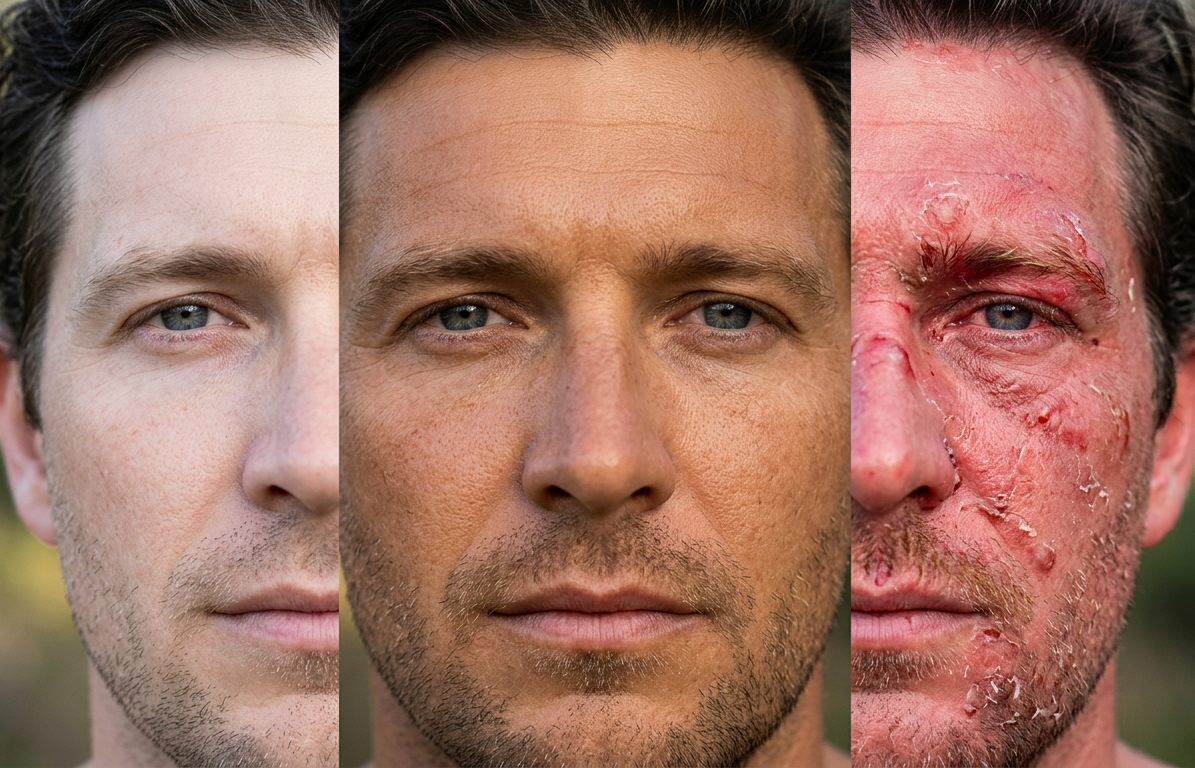
When the sun is out, it is easy to focus only on enjoying the warmth. But most people do not realize that skin damage starts long before you notice your skin turning red or feeling warm. True sun safety comes down to understanding the Minimal Erythema Dose (MED)—the exact amount of UV radiation it takes to cause visible reddening within 24 hours.
Because every person’s skin responds differently to UV light, the time it takes to reach that threshold depends entirely on your specific skin type and the strength of the sun.
Understanding Your Skin Type
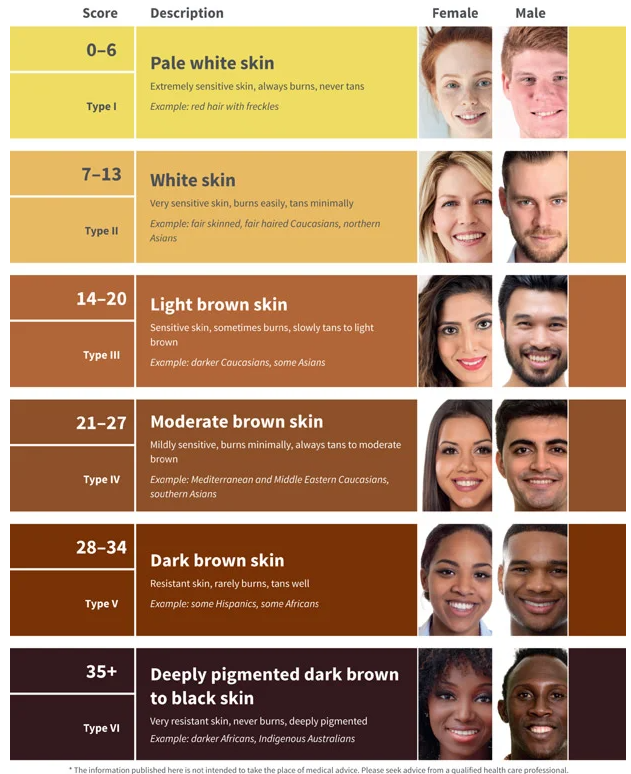
To figure out your individual risk, dermatologists use the Fitzpatrick Skin Score, which categorizes skin into six distinct types based on its natural pigment and how it reacts to initial sun exposure:
- Type I: Very fair skin, red or blonde hair, freckles. Always burns, never tans.
- Type II: Fair skin, light hair. Burns easily, tans minimally.
- Type III: Light brown or white skin. Burns moderately, tans gradually to a light brown.
- Type IV: Moderate brown/olive skin (e.g., Mediterranean, Hispanic, or Middle Eastern backgrounds). Burns minimally, tans easily to a moderate brown.
- Type V: Dark brown skin. Rarely burns, tans easily to a deep dark brown.
- Type VI: Deep brown to black skin. Never burns, tans very darkly and easily.
UV Index vs. Time to Burn (Unprotected Skin)
The following chart breaks down the estimated minutes it takes for unprotected skin to begin burning across all Fitzpatrick skin types, depending on the current UV Index.
| UV Index | Risk Level | Types I & II (Fair / Very Fair) | Types III & IV (Medium / Olive) | Types V & VI (Dark / Deep) |
| 1 – 2 | Low | 60 – 90+ mins | 90+ mins | 120+ mins |
| 3 – 5 | Moderate | 25 – 45 mins | 45 – 75 mins | 90 – 120 mins |
| 6 – 7 | High | 15 – 20 mins | 25 – 35 mins | 60 – 90 mins |
| 8 – 10 | Very High | 10 – 15 mins | 15 – 25 mins | 45 – 60 mins |
| 11+ | Extreme | < 10 mins | 10 – 20 mins | 30 – 45 mins |
Crucial Reminder: Skin damage and DNA mutations begin well before a visible burn appears. By the time you notice your skin turning pink or feeling warm, you have already exceeded your safe exposure limit.
3 Critical Factors That Change Your Risk
1. The “Base Tan” Myth
A common misconception is that having olive or darker skin, or having a pre-existing tan, eliminates the need for protection. While melanin offers some natural defense, a tan only provides an approximate SPF of 2 to 4. This is far below the minimum recommended level needed to prevent DNA damage, premature aging, and hyperpigmentation.
2. Reflection and Altitude Amplifiers
Surfaces like water, sand, concrete, and snow act as giant mirrors for UV rays. They can reflect up to 80% of the sun’s radiation back onto your skin, effectively hitting you twice. Furthermore, UV radiation levels increase by about 10% to 12% for every 1,000 meters of elevation gain.
3. UVA vs. UVB (The Invisible Aging Factor)
While the UV Index is primarily an indicator of UVB rays—the ones responsible for the physical burn—UVA rays are present at a high level all year round, even on cloudy days and during low UV Index periods. UVA rays penetrate deep into the dermis, breaking down collagen and causing long-term wrinkling, dark spots, and loss of elasticity.
The Verdict
Sunscreen isn’t just for long beach days; it is a daily skin health necessity for all skin types. To protect your skin’s health and longevity, opt for a broad-spectrum sunscreen with an SPF of at least 30, and reapply every two hours when outdoors.
📝 Addendum: Modern Sun Safety & The Bloodstream Debate
Important Update for Our Readers: > Since publishing this article, we’ve looked deeper into the latest dermatological science regarding how our bodies interact with what we put on our skin. Here is what you need to know about application timing and absorption:
- The Reapplication Rule: No matter how high your sunscreen’s SPF is, it is not an all-day shield. Standard clinical guidelines dictate that sunscreen must be reapplied at least every two hours (and immediately after swimming or heavy sweating). SPF multipliers only estimate initial protection—they do not account for the product breaking down under active UV light.
- Chemical vs. Mineral Absorption: Recent clinical studies have confirmed that common chemical sunscreen filters (like Oxybenzone and Avobenzone) are readily absorbed through the skin barrier and can be detected in the bloodstream after use. While research into the long-term health effects of this absorption is ongoing, it has sparked a massive regulatory shift toward modern, safer filters.
- The Zinc Oxide Shield: If you want to completely avoid systemic bloodstream absorption, Mineral (Physical) sunscreens using Zinc Oxide or Titanium Dioxide are the gold standard. Even at the nanotechnology level, zinc oxide particles sit safely on the surface of the skin like a mirror to reflect UV rays, never penetrating deep enough to enter your blood vessels.
Summarized by AI, Not reviewed and verified by a Human.
sources:
https://www.heatwaveworcester.co.uk/tanning-worcester/fitzpatrick-skin-type/
Avila, M., et al. (2009). The Oral Microbiome: From Healthy to Diseased. In Journal of California Dental Association. (Used for concepts regarding competitive exclusion and pathogen management in the mouth, reinforcing the overall biological message of the ecosystem).
Fitzpatrick, T. B. (1988). The Validity and Practicality of Sun-Reactive Skin Types I Through VI. In Archives of Dermatology. (The foundational system used to define the skin types cited in the chart).
Health Canada. The UV Index: Sun Protection. Ottawa: Government of Canada. (Data on the 50% Rule and standardized UV Index exposure times based on skin sensitivity).
Kreth, J., et al. (2016). Microbial Competition and Commensalism in the Oral Cavity. (Relevance: Defines biological competitive mechanisms and chemical warfare, supporting the initial article’s message about bacterial balance).
World Health Organization (WHO). Global Solar UV Index: A Practical Guide. Geneva: WHO. (Used to standardize the “Risk Level” category, the defining threshold of the Minimal Erythema Dose, and generalized exposure limits for standardized skin models).
Zaura, E., & Twetman, S. (2019). Microbiome: A Critical Player in Oral Health and Disease. In Best Practice & Research Clinical Gastroenterology. (Relevance: Information regarding pH balancing and acid neutralization by “good” bacteria).
American Academy of Dermatology (AAD) Guidelines: Clinical standards confirm that sunscreen efficacy degrades from direct UV exposure, physical rubbing, and sweat, establishing the mandatory 2-hour reapplication standard regardless of SPF value.
Australian National Health and Medical Research Council (NHMRC): Long-term multi-year population studies (such as the landmark Nambour Skin Cancer Trial) proving that consistent, timed daily application dramatically reduces both squamous cell carcinoma and skin photoaging.
The Landmark FDA Clinical Trials (JAMA, 2019 & 2020):
- Matta, M. K., et al. (2019). “Effect of Sunscreen Application Under Maximal Use Conditions on Plasma Concentrations of Sunscreen Active Ingredients: A Randomized Clinical Trial.” JAMA. This study proved that active chemical ingredients (Avobenzone, Oxybenzone, Octocrylene, and Ecamsule) systemic absorption quickly exceeded the FDA safety threshold ($0.5 \text{ ng/mL}$) within just hours of application.
- Matta, M. K., et al. (2020). “Effect of Sunscreen Application on Plasma Concentration of Sunscreen Active Ingredients: A Randomized Clinical Trial.” JAMA. Expanded the research to 6 active chemical filters, confirming systemic accumulation over multiple days of standard use.
The Human In-Use Validation Study: * Mohammed, Y. H., et al. (2018). “Support for the Safe Use of Zinc Oxide Nanoparticle Sunscreens: Lack of Skin Penetration or Cellular Toxicity after Repeated Application in Volunteers.” Journal of Investigative Dermatology. This human trial utilized multiphoton tomography to directly prove that even tiny nano-sized Zinc Oxide particles remain exclusively within the dead, outermost layer of the skin (stratum corneum) and do not access living epidermal cells or the bloodstream.
The European Scientific Committee on Consumer Safety (SCCS): Formal toxicological evaluations confirming that topically applied Zinc Oxide (both nano and non-nano forms) is safe for intact skin barriers because its structural layout prevents transdermal delivery into internal blood systems.