
Posted on May 4, 2026
Stop Nuking Your Mouth: The Truth About “Toxic” Toothpaste
Most people don’t realize their mouth is a delicate ecosystem, not a bathroom floor that needs to be bleached. If you’ve ever looked at your toothpaste tube and seen a “Poison Control” warning, you’ve probably wondered: Why am I putting this in my body twice a day?
The Myth of “Kill All Bacteria”
We’ve been conditioned to think all bacteria are bad. Wrong. A healthy mouth needs “good” bacteria to:
- Pre-digest food.
- Keep your breath fresh naturally.
- Prevent “bad” bacteria from moving in and causing cavities.
When you use harsh, antibacterial toothpastes, you’re basically dropping a nuclear bomb on your oral microbiome. You might kill the germs, but you’re also killing your mouth’s natural defenses.
Red Flags: What to Avoid
If your current tube has these on the ingredient list, it might be time for a change:
- Triclosan: A heavy-duty antibacterial that can disrupt your hormones and gut health.
- Sodium Lauryl Sulfate (SLS): The chemical that makes toothpaste foam. It’s a harsh detergent that can cause canker sores and irritate your gums.
- Artificial Colors & Sweeteners: Your teeth don’t care if your toothpaste is blue. These are just extra chemicals your body doesn’t need to process.
The New Standard: What to Buy
You don’t have to sacrifice clean teeth to stay safe. Look for these “smart” ingredients instead:
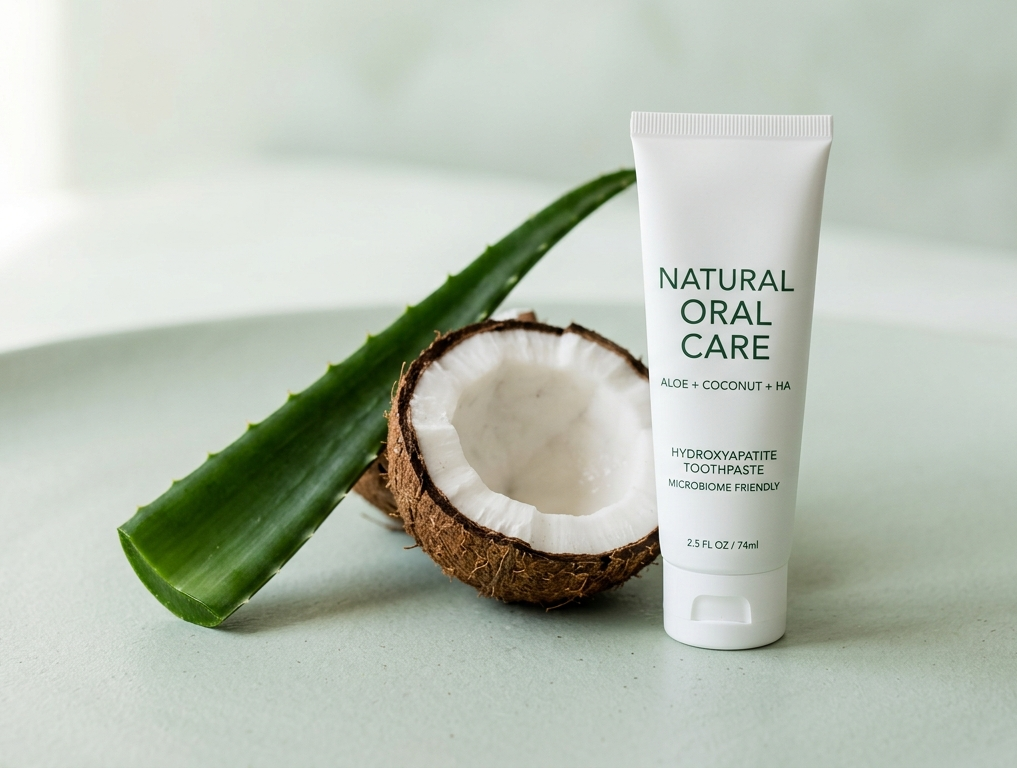
- Hydroxyapatite (HAp): This is what your teeth are actually made of. It remineralizes your enamel naturally and is 100% safe to swallow.
- Xylitol: A natural sweetener that starves the bad bacteria without hurting the good ones.
- Aloe Vera or Coconut Oil: These soothe the gums and manage bacteria without the “burn” of alcohol or chemicals.
The 60-Second Audit: Go to your bathroom right now and check your label. If “Triclosan” or “SLS” is near the top, your toothpaste is working against your body’s natural chemistry.
The goal isn’t a sterile mouth—it’s a balanced one. Switch to a microbiome-friendly paste and let your “good” bacteria do the heavy lifting for you.
Scientists have discovered that dental health is not just about the absence of germs, but rather a “war” between beneficial and harmful bacteria. In a healthy mouth, “good” commensal microbes actively prevent tooth decay through several biological mechanisms.
1. Competitive Exclusion
The first way good microbes protect your teeth is by simply taking up space. Commensal bacteria like Streptococcus sanguinis and Streptococcus mitis are primary colonizers that adhere to the tooth surface (Kreth et al., 2016). By occupying these attachment sites and consuming available nutrients, they prevent cavity-causing pathogens like Streptococcus mutans from establishing a foothold (Avila et al., 2009).
2. Chemical Warfare (Hydrogen Peroxide)
Some beneficial bacteria produce natural “antibiotics” to kill off their competition. For example, Streptococcus sanguinis produces hydrogen peroxide (H_2O_2), which is toxic to the bacteria that cause cavities (Baty et al., 2022). This chemical defense helps maintain a stable, healthy environment where decay-causing microbes cannot thrive (Kreth et al., 2016).
3. pH Balancing (Ammonia Production)
Cavities occur when the mouth becomes too acidic, which dissolves tooth enamel. Scientists have found that certain “good” bacteria metabolize substances like arginine and urea to produce ammonia (Zaura & Twetman, 2019). This ammonia acts as a base, raising the pH of the mouth and neutralizing the acids produced by sugar-eating bacteria, effectively “buffering” the teeth against decay (Zaura & Twetman, 2019).
4. Immune Regulation
Commensal microbes also act as “gatekeepers” that help regulate the host’s immune response (Baty et al., 2022). They help the body distinguish between harmless residents and dangerous invaders, preventing the excessive inflammation that can lead to gum disease and further tooth damage.
TLDR:
Look For
- Hydroxyapatite
- Xylitol
- SLS-Free
- Natural Oils
Avoid
- Alcohol
- Triclosan
- Artificial Colors
- Artificial Sweeteners
Source:
Summarized by AI, Not reviewed and verified by a Human.
Avila, M., Ojcius, D. M., & Yilmaz, Ö. (2009). The oral microbiota: Living with a permanent guest. DNA and Cell Biology, 28(8), 405–411. https://doi.org/10.1089/dna.2009.0874
Cited by: 818
Baty, J. J., Stoner, S. N., & Scoffield, J. A. (2022). Oral commensal streptococci: Gatekeepers of the oral cavity. Journal of Bacteriology, 204. https://doi.org/10.1128/jb.00257-22
Cited by: 167
Kreth, J., Giacaman, R. A., Raghavan, R., & Merritt, J. (2016). The road less traveled – defining molecular commensalism with Streptococcus sanguinis. Molecular Oral Microbiology, 32(3), 181–196. https://doi.org/10.1111/omi.12170
Cited by: 118
Zaura, E., & Twetman, S. (2019). Critical appraisal of oral pre- and probiotics for caries prevention and care. Caries Research, 53(5), 514–526. https://doi.org/10.1159/000499037
Cited by: 189